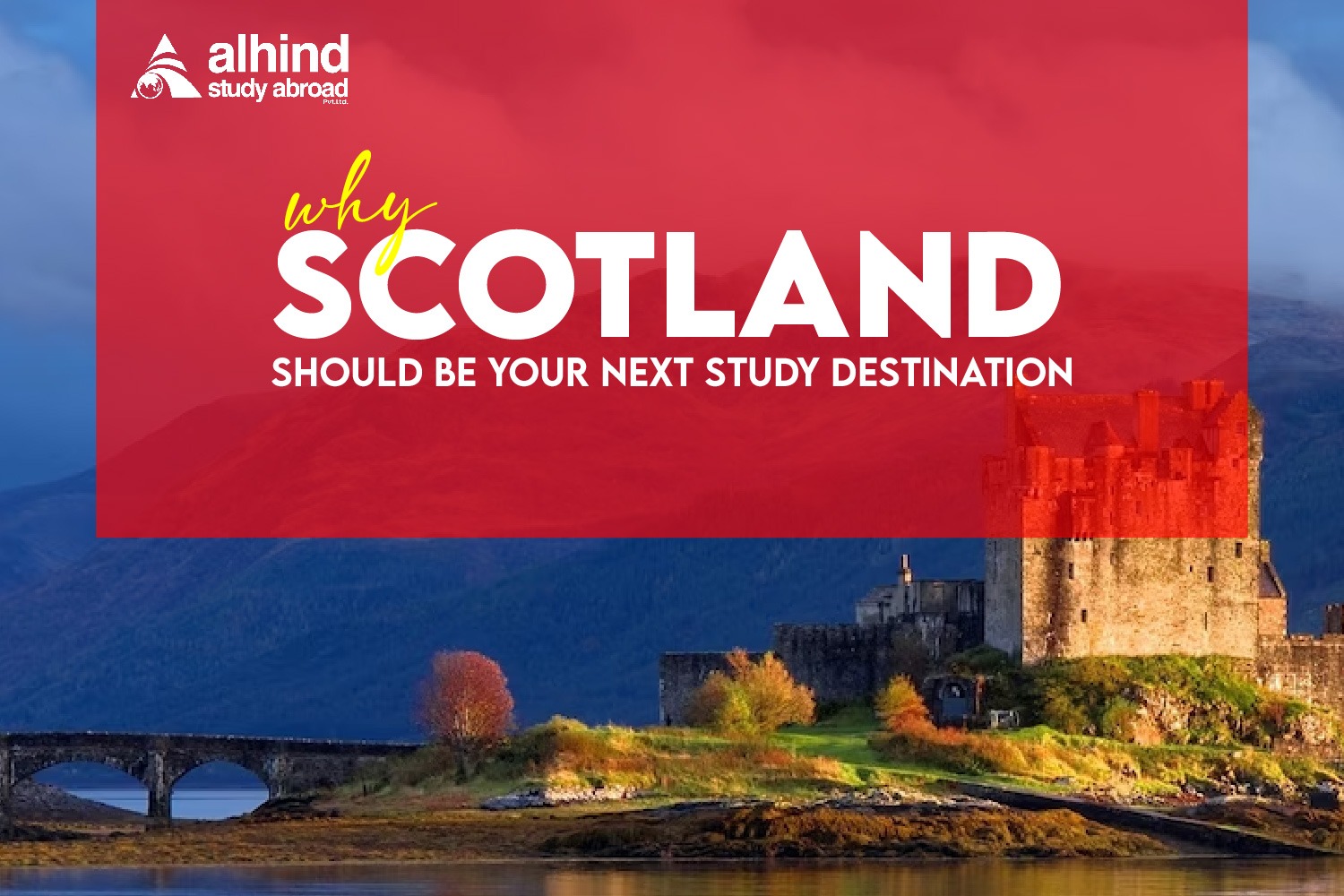
A moment that almost every international student who comes to Scotland has to go through, usually within the first few weeks. You're probably walking somewhere ordinary, maybe cutting across a cobbled street on the way to a lecture, and all of a sudden, it hits you; it becomes real: it feels like you are living a dream.
And not in an Instagram way, but in a quieter, harder to put it into words kind of way.
Sure, Scotland doesn't have the global name recognition or popularity unlike London or New York. It's not loud. But once you spend a semester here, you'll start to understand why over 73,000 international students from 150 countries choose it every year and why so many of them end up staying longer than they planned.
The Golden Universities of Scotland
The University of St Andrews was founded in 1413. Glasgow in 1451. Edinburgh in 1582. These aren't institutions just surviving on old reputations, they've had six hundred years to curate the finest learning experience in the world, and it shows.
Three Scottish universities sit inside the Times Higher Education global top 200. For a country with a population smaller than many cities, that's extraordinary. But the ranking is almost beside the point. What matters day-to-day is what happens inside the lecture halls and labs. The quality of supervision, the standard of debate, the expectation that you come to tutorials ready to think, not just to listen. This is what really matters.
Students who arrive expecting to blend into a lecture hall of three hundred and coast through on recorded slides usually find Scotland does things differently.
Four Years That Actually Make Sense
One of the less-discussed advantages of studying in Scotland is the structure of the undergraduate degree, four years rather than the three you'd do in England.
The first two years are deliberately made broad. You're not restricted to taking a single subject from day one. You can take modules across disciplines, find the discipline which genuinely interests you, and then specialize in that particular subject in years three and four. If you change direction after your first year, you don't lose time. You just adapt and carry on.
This sounds simple, but it's rarer than you'd think. Most education systems ask you to decide what you want to study before you've studied anything. Scotland's approach acknowledges that eighteen-year-olds often don't know yet and builds the flexibility in rather than punishing you for it.
For those coming to do a Master's, most programs here run for one year. The same qualification that takes two years in the US or Australia takes twelve months in Scotland. The pace is intense, but the savings in terms of fees, time, and opportunity cost is significant.
You Can Study Things That Don't Exist Elsewhere
The University of Dundee offers a postgraduate program in forensic odontology, which is the science of identifying individuals through dental records in criminal cases and disasters. At the time one Pakistani student enrolled, it was the only such course in the UK. As part of her studies, she worked directly with local police and mortuaries. The most interesting thing being that the classroom and the real world were, for her, the same place.
That's not unusual in Scotland. Across its 19 institutions, there are more than 4,500 courses in over 150 subject areas. Many are designed with direct industry input. In Edinburgh, a Master's student studying climate finance spent a module building an equity portfolio from actual S&P 500 data, then presented her recommendations to working asset managers. Professionals from McKinsey came into her classroom to discuss their own experience.
This is how Scottish universities seem to prefer doing things — not theory sealed off from practice, but the two running alongside each other.
The Cost of Being Here is Lower Than Most People Expect
Scotland costs roughly half what is required to live in London. That difference makes a huge difference when you're budgeting for rent, food, transport, and everything else that comes with being a student in a new country.
Many scholarships are overlooked by international applicants. Chevening, Commonwealth, GREAT, and Fulbright scholarships all operate here, alongside institution-specific awards and, less commonly known, sanctuary scholarships for students forced to flee conflict. Some cover only fees. Others cover fees, accommodation, and flights.
An interesting fact - if you're under 22, you're entitled to free bus travel across Scotland regardless of where you're from. That includes cross-country routes to the Highlands, the coast, and smaller towns that don't make it onto the tourist maps.
Getting a Job After You Graduate isn't Left To Chance
Scottish universities are unusually deliberate about employability. Career services at most institutions offer more than a job board, including mock interviews, CV coaching, visa guidance for international graduates, and connections to industry placements while you're still studying.
The industries are there too. Scotland has growing sectors in technology, renewable energy, healthcare, life sciences, and financial services. Amazon, Barclays, HSBC, GlaxoSmithKline, BP, and Diageo all have significant operations in the country. The graduate employment figures reflect this, with 95% of graduates from Scottish universities in employment or further training within six months of finishing their degree.
The Social Side is Hard to Summarize, But Easy to Feel
Across Scotland's universities, there are over a thousand student societies and five hundred sports clubs. A South African student studying mechanical engineering in Dundee joined a surfing club which includes cold water, grey skies, North Sea swells and called it one of the things he least expected to love about his time there.
Glasgow hosts around 130 live music events every week. Edinburgh's Festival Fringe, running every August, is the largest arts festival in the world. Hogmanay which is Scotland's version of New Year's Eve is the kind of event that gets inside you.
The people, though, are what most students mention first when asked what surprised them. Scotland has a reputation for being welcoming that, unusually, appears to be accurate. Students from Kerala, Kenya, Germany, Indonesia, Pakistan, and Malaysia have all said roughly the same thing: the locals are genuinely kind, and the international community is close-knit in a way that doesn't always happen in bigger cities.
The Landscape Deserves Its Own Mention
There are parts of Scotland that look like they were invented for a novel. The Highlands. The sea lochs. The islands off the west coast. Edinburgh's Old Town at sunset. The Cairngorms in early winter.
Students who come for the degree often leave having also fallen in love with its history, its architecture, its traditions, its sheer visual drama. The Jacobite Steam Train still crosses the Glenfinnan Viaduct. Several of the filming locations used in Outlander and Game of Thrones are an afternoon's trip from most campuses.
Travelling elsewhere from Scotland is also straightforward. London is under an hour by air. Paris is under two. The country sits at a useful intersection for anyone who wants Europe accessible without paying European capital-city prices to live.
Scotland is the kind of place that rewards the decision to go. The academic environment is serious without being cold. The cost of living makes it possible to actually enjoy being a student while at the same time, the career outcomes are strong. And the experience of living there, including the culture, the landscapes, and the people, tends to stay with graduates long after they've left.
Most of them, asked in hindsight, say they'd do it all over again without thinking twice.